Empowering Learning Through Seamless
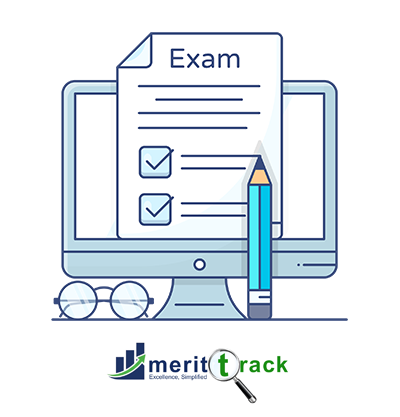
An online exam is a digital method of conducting assessments using computers, tablets, or mobile devices through an internet-based platform. Instead of writing on paper in a physical hall, students can take their exams from any location, following secure, automated, and technology-enabled processes.
Online exams are widely used by universities, schools, training institutes, competitive exam bodies, and corporate organizations because they offer flexibility, efficiency, and quick evaluation.
Key Features
Flexibility & Convenience
Students can attend exams from home or designated centers at their preferred time slots.
Automated Question Delivery
Questions are randomly generated, timed, and displayed through a secure system.
Proctoring Options
AI-based or live proctors monitor the exam using webcam, mic, and screen monitoring to maintain integrity.
Instant Results
Objective-type questions can be auto-evaluated, ensuring fast result generation.
Secure & Transparent
Encrypted systems, unique login credentials, and audit logs ensure fairness and data safety.
Advantages of Online Exams
Advantages of Online Exams
-
Saves time for both examiners and students
-
Reduces administrative burden (printing, seating, invigilation).
-
Enables remote access and wider reach.
-
Supports multimedia questions (images, audio, video).
-
Provides analytics for student performance improvement.
About Proctored Online Exam
About Proctored Online Exam
A proctored online exam is a secure digital method of conducting examinations in which candidates take the test remotely while being monitored through technology. The proctoring ensures that the identity of the candidate is verified and that the exam is conducted fairly without malpractice. This system combines the convenience of online exams with the integrity of traditional invigilation.
How It Works- Identity Verification: Candidates must authenticate their identity using ID proof, webcam checks, and sometimes AI-based facial recognition.
- Live or AI Monitoring: Exams are supervised either by a human proctor watching through a webcam or by AI tools that track screen activity, background noise, eye movement, and suspicious behavior.
- Secure Browser: A restricted or locked-down browser prevents opening new tabs, taking screenshots, or accessing other applications.
- Recording & Audit Logs: The entire exam session (video, audio, screen) may be recorded and stored for review.
- Live Proctoring: Human invigilators monitor candidates in real time.
- AI Proctoring: Automated software detects anomalies and flags suspicious activity.
- Hybrid Proctoring: Combination of AI detection with human review for maximum accuracy.
- Guarantees fairness and academic integrity.
- Allows candidates to take exams from home or remote locations.
- Reduces the cost and logistics of physical exam centers.
- Enables large-scale examinations with reliable monitoring.
- Provides detailed reports and recordings for verification.
Key Resulted Area
AI-Powered Behavioral Analytics
- Proctoring systems are increasingly using advanced AI to analyze not just face or eye movements but behavioral patterns — like typing dynamics, mouse movement, interaction patterns, and temporal behavior — to detect suspicious behavior.
- This helps in reducing false positives and making the monitoring more context-aware.
Continuous & Multimodal Authentication
- Instead of just a one-time identity check at the start, platforms are using continuous authentication throughout the exam via biometrics (face recognition, keystroke dynamics, voice).
- This ensures the same person stays logged in during the entire exam session.
Hybrid Proctoring Models
- There’s a growing adoption of hybrid models where AI does the first line of monitoring, and human proctors intervene or review only when the AI flags something.
- This balances scalability (via AI) with accuracy and human judgment (via human proctors).
Privacy-First Design
- Given privacy concerns, modern proctoring systems are trying to minimize how much data they collect.
- Some are using edge computing so that data processing (e.g. liveness detection) happens on the user’s device, and only necessary alerts or “risk scores” are sent to the cloud.
Blockchain for Exam Integrity
- Blockchain is being explored to create immutable logs of exam sessions — every event (video, alerts, submission) can be timestamped and stored in a distributed ledger to ensure tamper-proof exam records.
- This helps in auditability and dispute resolution (e.g., if a student disputes a flag or result) because the record can’t be altered.
Edge-Cloud Architectures & Resilient Systems
- Proctoring platforms are building hybrid edge-cloud systems to manage variable student device capabilities and network conditions.
- Using on-device AI for critical checks ensures smoother performance and lower bandwidth dependency, while less critical data can be synced when connectivity is stable.
Defense Against AI-Enabled Cheating
- With generative AI (like LLMs), there’s a risk of students using tools to get answers during exams. Proctoring systems are evolving to “defend against AI” by detecting unnatural patterns, automated overlays, or suspicious content injection.
- At the same time, generative AI is being used positively — to summarize proctoring session videos, generate review reports, and flag suspicious segments for human review.
Multilingual / Culturally Adaptive Proctoring
- Proctoring systems are becoming more inclusive — supporting multiple languages and using culturally adaptive behavioral models so that the system doesn’t misinterpret behaviors from different cultural contexts.
- This helps in reducing bias and ensuring fairness in global or diverse assessments.
Multi-Camera / 360-Degree Room Scans
- Use of dual or multi-camera setups (webcam + mobile) is on the rise to ensure the proctoring system can monitor not just the test-taker’s face and screen, but also the surroundings.
- Some tools also ask students to do a 360° room scan before starting the exam to ensure no unauthorized materials are in the space.
Edge AI & Federated Learning
- Some proctoring vendors are exploring federated learning approaches to train AI models across devices without centralizing sensitive video data, thus preserving privacy.
- They’re also using differential privacy and feature-hashing to send only abstracted data rather than raw video or audio.
Contact Us!
Merittrack Online exam
Info@merittrack.in
Support
Support@merittrack.in
Demo
support@merittrack.in